SmolVLA for Language-Conditioned Robot Action Prediction
Recruiter summary
- Built: An open-loop inference workflow for measuring prompt sensitivity and temporal variation in predicted actions on real robot observations.
- Validated: Eight BridgeV2 episodes, 80 sampled frames, and six prompts, with seven open examples and one exploratory close example.
- Why it matters: Quantifies how a pretrained vision-language-action model's predictions vary with observations and prompts without claiming closed-loop task success.
Overview
Applied SmolVLA-450M, a pretrained vision-language-action model, to sampled BridgeV2 real-robot observations to study how prompts influence open-loop action predictions for drawer-opening and drawer-closing examples.
The project measures whether predicted actions differ across prompts, how much they vary across similar episodes, and how they evolve over a sampled sequence. It does not execute the predictions on a robot or measure task success.
Dataset and Model Setup
The project uses BridgeV2, a dataset of real WidowX robot manipulation demonstrations from UC Berkeley RAIL, focusing on drawer open / close tasks.
Dataset
- 8 episodes total
- 7 open-drawer episodes
- 1 close-drawer episode
- 80 frames total
- 256×256 RGB observations
Model
- Checkpoint:
lerobot/smolvla_base - Parameters: 450M
- Action space: 6D end-effector deltas
(dx,dy,dz,droll,dpitch,grip)
Analysis Focus
The project explored four key questions:
- How do predicted open and close action vectors differ in this sample?
- How variable are action predictions across multiple episodes with the same label?
- Does the model respond differently to semantically different language instructions on the same image?
- How does action behavior evolve over time during an episode?
Open vs Close Action Separation
A key result in the supplied run was that sampled open and close predictions differed most strongly in dy (0.562), followed by grip (0.461) and dz (0.458).
- dy difference:
0.562 - grip difference:
0.461 - dz difference:
0.458
These differences show that the model did not produce one identical mean action vector for both sampled task labels. Because the evaluation includes seven open episodes but only one close episode—and uses a zero-valued state placeholder—the comparison is exploratory rather than a balanced physical-control benchmark.
Action Consistency and Language Grounding
Across the 7 open-drawer episodes, the model showed varying consistency across action dimensions:
- dpitch was the most consistent dimension
- grip was the most variable
- translational components showed moderate variation depending on trajectory
Instruction sensitivity analysis showed that the model produced distinct predicted action distributions for different instructions on the same image, indicating genuine language conditioning.
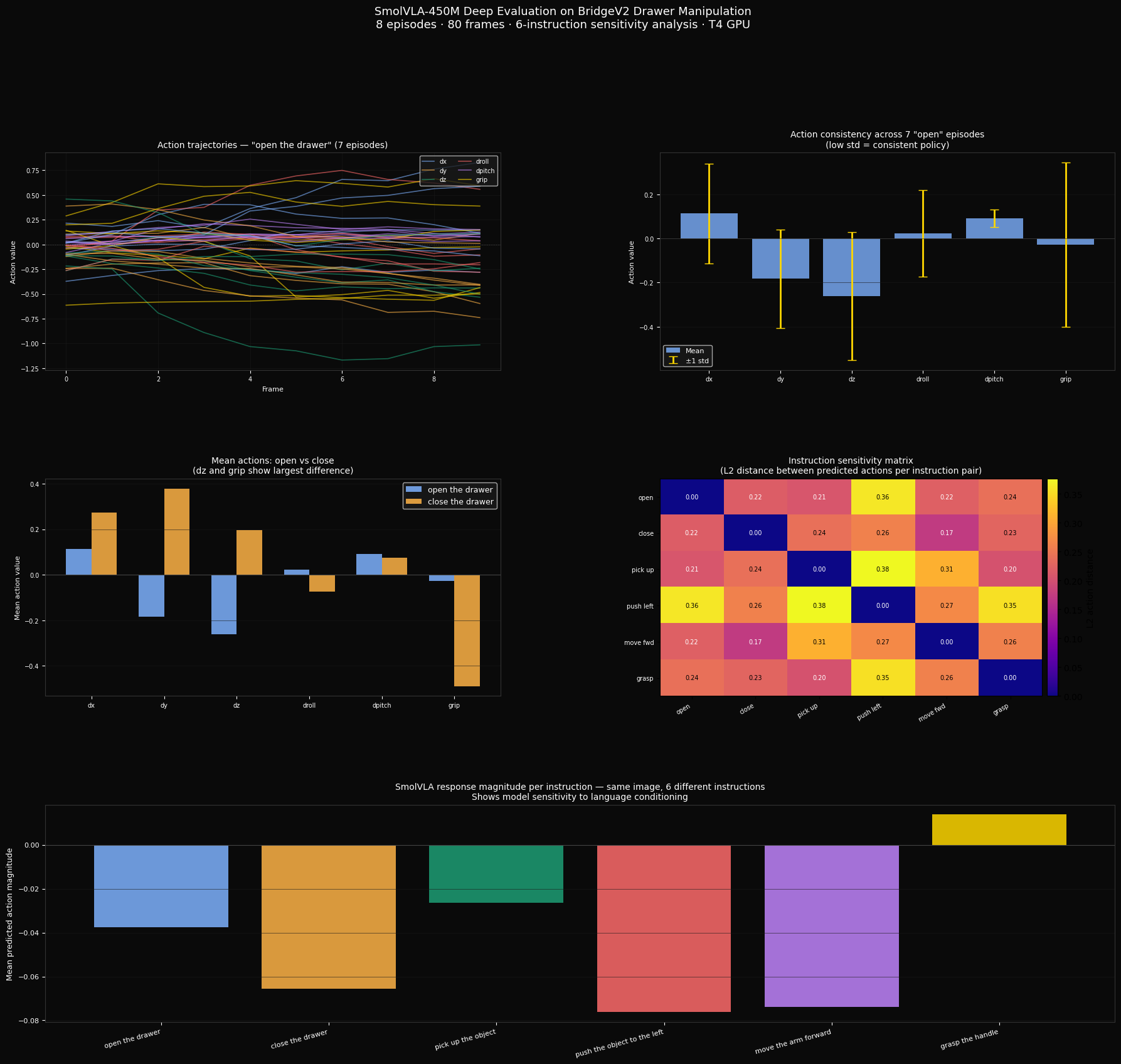
Action consistency and instruction sensitivity across multiple language prompts.
Key findings
- mean pairwise L2 distance across prompts: 0.262
- max pairwise L2 distance: 0.376
- model behavior changed meaningfully under different natural-language commands
Temporal Behavior Analysis
Temporal analysis showed that model behavior evolved across an episode rather than remaining static.
Key observations:
dpitchhad the lowest mean per-frame standard deviation (0.048)griphad the highest mean per-frame standard deviation (0.393)- cumulative motion magnitude was
3.623for the mean open trajectory and7.580for the single close trajectory - action values evolved across the ten sampled frames rather than remaining constant
This shows temporal structure in the predicted action sequence; it does not establish closed-loop task completion.
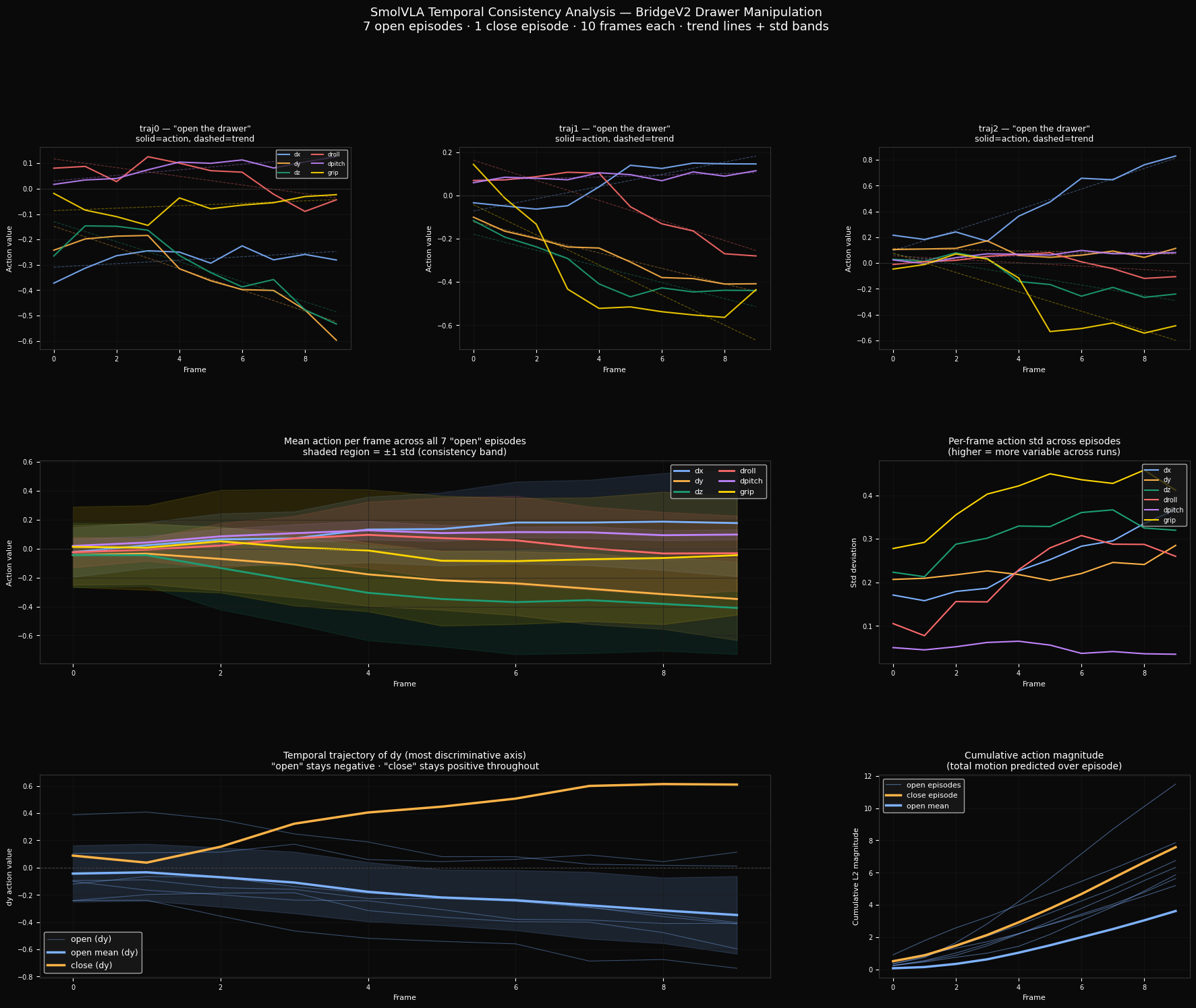
Temporal trends in action predictions, variance, and cumulative motion.
Results Summary
Strongest quantitative outcomes
- dy separation:
0.562between sampled open and close predictions - grip separation:
0.461 - dz separation:
0.458 - mean prompt sensitivity:
0.262pairwise L2 distance - most consistent dimension:
dpitch - most variable dimension:
grip - close cumulative motion:
7.580 - open cumulative motion:
3.623
Interpretation
The sampled predictions suggest that the pretrained SmolVLA policy:
- produces different mean vectors for the sampled task labels
- is sensitive to prompt changes in the sampled image
- exhibits structured temporal behavior
- produces structured but variable action distributions
Technical Stack
- Python
- Hugging Face Transformers
- LeRobot
- SmolVLA-450M
- BridgeV2 dataset
- NumPy / Matplotlib
- action-space statistics and temporal analysis
Engineering Insights
- pretrained VLA predictions can be measurably prompt-sensitive without task-specific retraining; closed-loop tests are still required to establish language grounding and task success
- action-space analysis is effective for evaluating robot policy behavior
- temporal analysis reveals confidence trends that single-frame evaluation cannot capture
- simple tasks like drawer manipulation are useful probes for prediction structure before closed-loop evaluation
Future Improvements
- evaluate additional BridgeV2 task categories
- compare against other VLA models
- extend from analysis to rollout-based policy evaluation
- test robustness under ambiguous or conflicting instructions
- analyze internal representations and attention behavior
Continue Exploring
See another system
Interested in the engineering behind this work? I am available to discuss robotics software, embedded systems, autonomy, controls, and robot-learning opportunities.