Stereo Visual-Inertial SLAM with Optimization and Loop Closure
Stereo Visual-Inertial SLAM with Optimization and Loop Closure
Recruiter summary
- Built:
- Validated:
- Why it matters:
Overview
Built a stereo visual-inertial SLAM pipeline on the EuRoC MAV dataset, starting from feature tracking and stereo geometry and extending through visual odometry, IMU-assisted estimation, local optimization, loop closure, and sparse 3D mapping.
The notebooks combine stereo tracking, PnP-based motion estimation, IMU-informed pose refinement, bundle adjustment, and graph-based loop-closure experiments. They retain both improvements and negative results: the strongest short-window run improves substantially, while some full-sequence optimization variants provide little benefit or increase error.
An additional AAP-SLAM-ORB + NoMaD notebook explores a related ORB-based frame-to-map frontend and converts its keyframes into a topological graph for goal-conditioned navigation. Its executed run processed 3,630 EuRoC MH_01_easy frames, achieved 0.9002 m aligned SLAM ATE RMSE, and produced a graph with 244 nodes. The repository includes both the supplied real-nomad.pth run and an alternate architecture notebook documenting the earlier lightweight fallback.
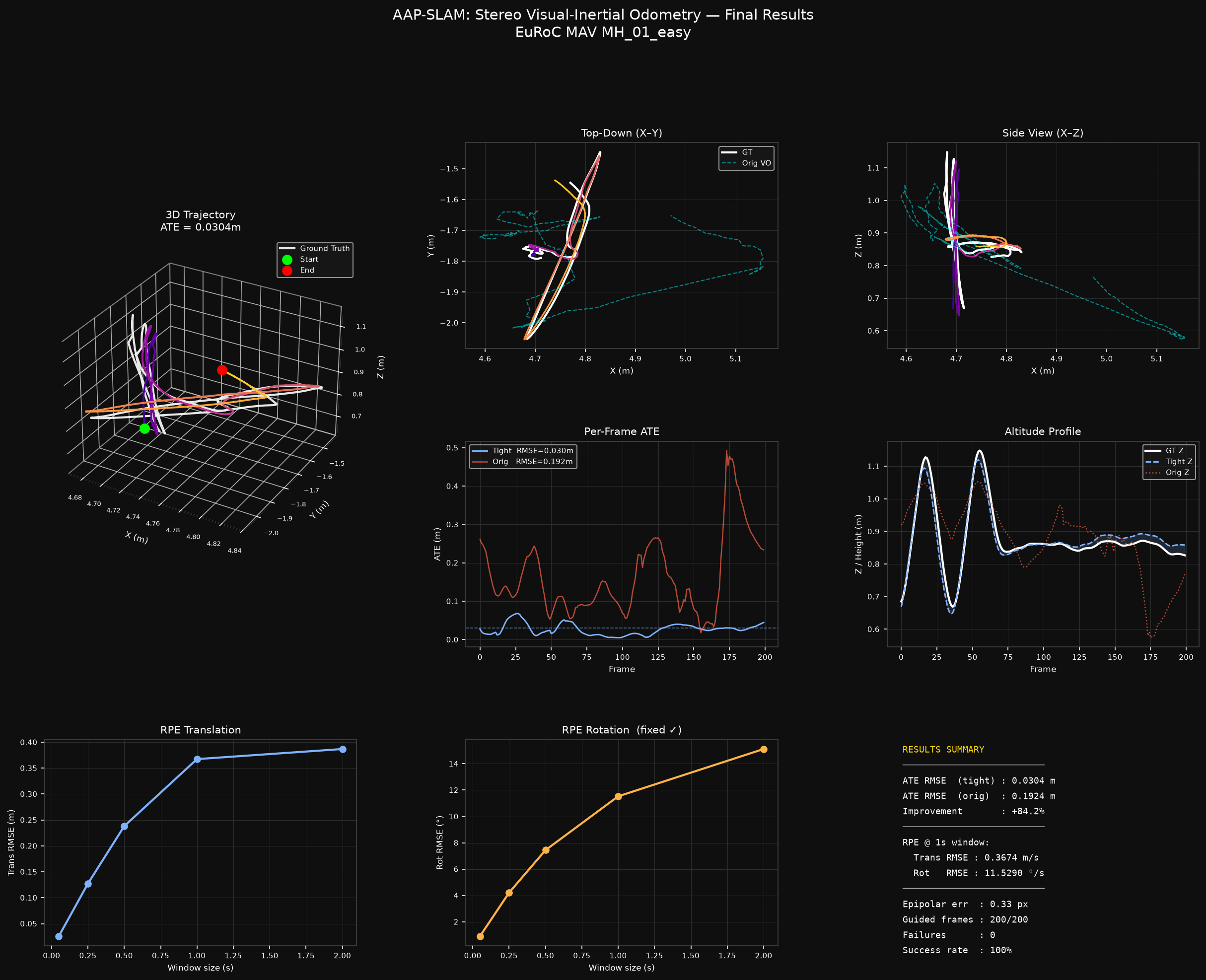
Final result summary showing trajectory alignment, 3D motion structure, and visual-inertial performance improvement.
Pipeline Overview
The system was built as a staged SLAM pipeline:
- stereo image loading and calibration parsing from EuRoC MAV
- stereo rectification and epipolar consistency verification
- LK optical flow tracking across frames
- stereo depth estimation through disparity / triangulation
- frame-to-frame motion estimation using visual correspondences
- IMU-assisted visual odometry refinement
- local and sliding-window bundle adjustment
- loop closure through keyframe graph optimization
- sparse 3D landmark map generation
- evaluation using trajectory alignment and error metrics
Frontend: Tracking, Stereo Geometry, and Depth
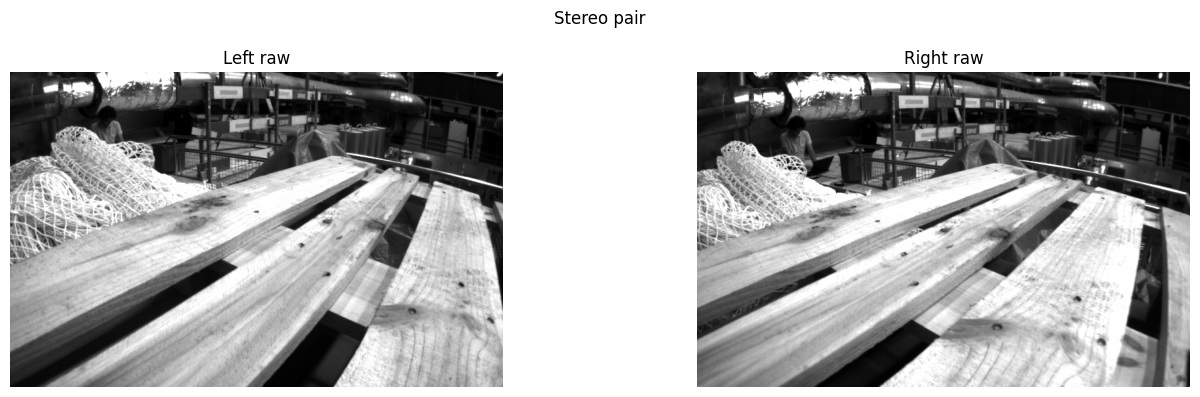
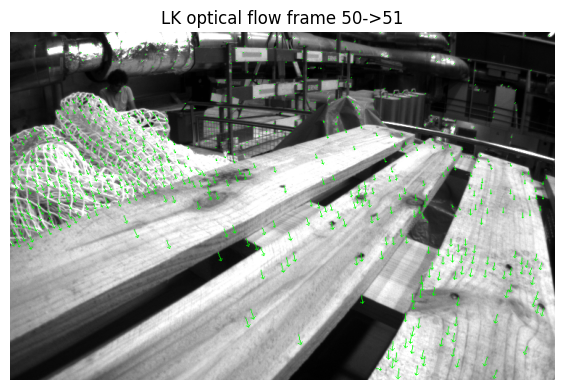
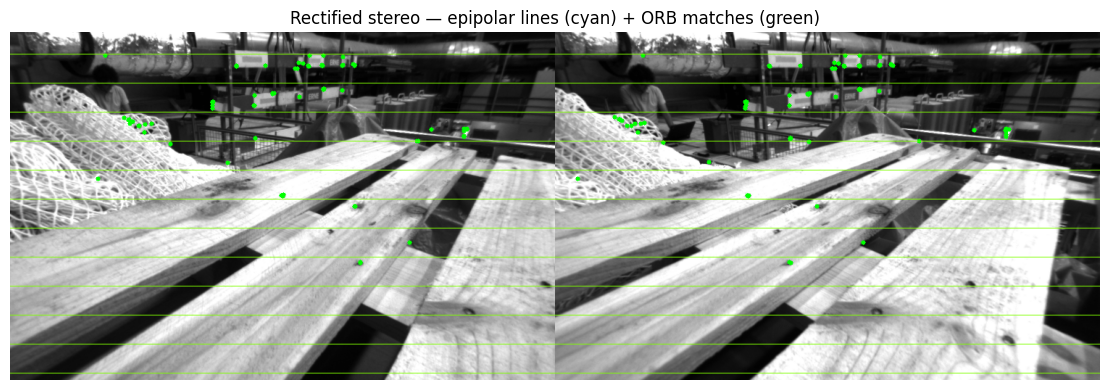
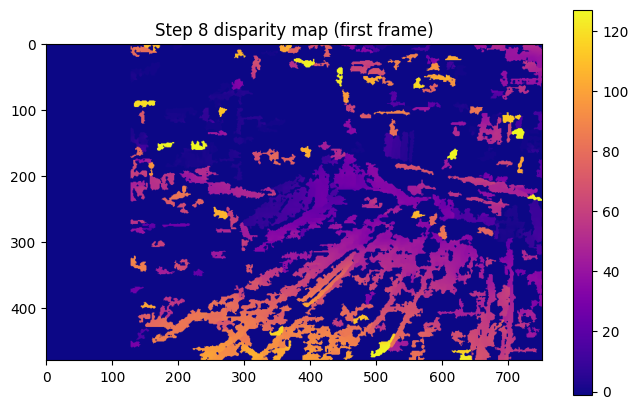
The frontend used stereo image pairs and tracked visual features across time using Lucas-Kanade optical flow. Stereo correspondences and rectification were used to enforce geometric consistency and recover depth for tracked points.
Baseline Visual Odometry
Using tracked features and stereo-derived 3D structure, the baseline system estimated frame-to-frame motion and recovered a visual odometry trajectory. This baseline established the reference point for later improvements.
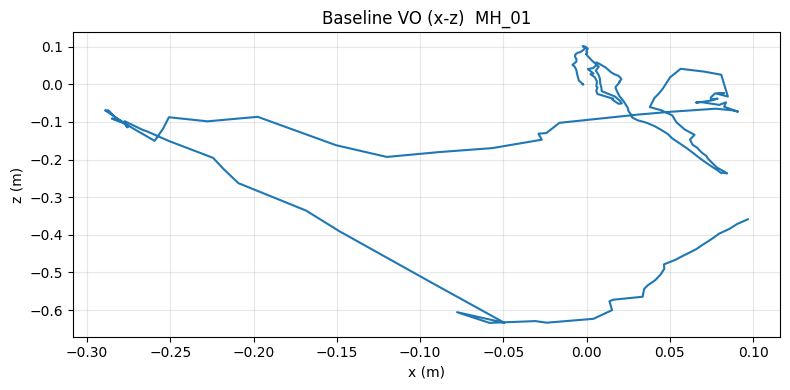
Baseline stereo visual odometry before visual-inertial refinement and backend optimization.
The baseline pipeline worked, but accumulated noticeable drift over longer horizons, motivating the addition of IMU-informed estimation and backend optimization.
Visual-Inertial Improvement
To improve rotational stability and overall trajectory consistency, IMU information was incorporated into the pipeline. This produced a substantially tighter trajectory estimate than the visual-only baseline.
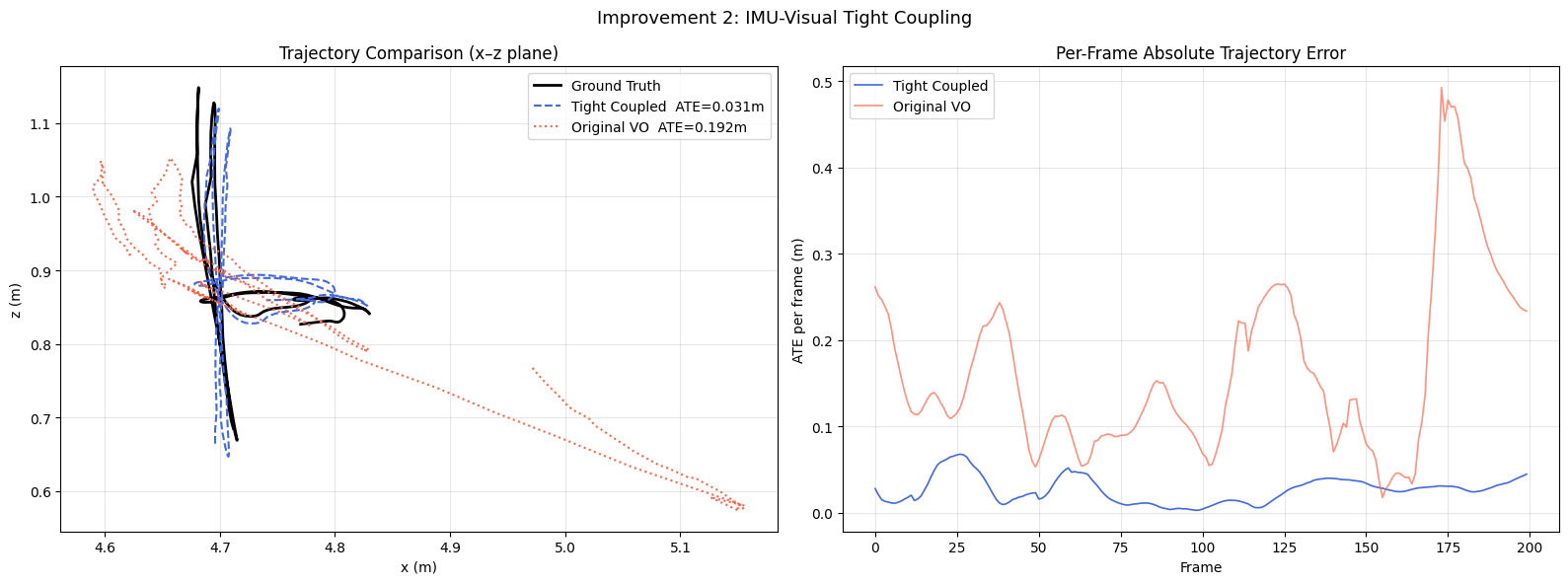
Visual-inertial refinement significantly improved alignment with ground truth compared to the original visual-only estimate.
Backend Optimization
After the frontend and visual-inertial estimation stages, local and sliding-window bundle adjustment reduced reprojection error in the optimized windows. In the fresh run, this did not improve global ATE, reinforcing the distinction between local objective improvement and trajectory accuracy.
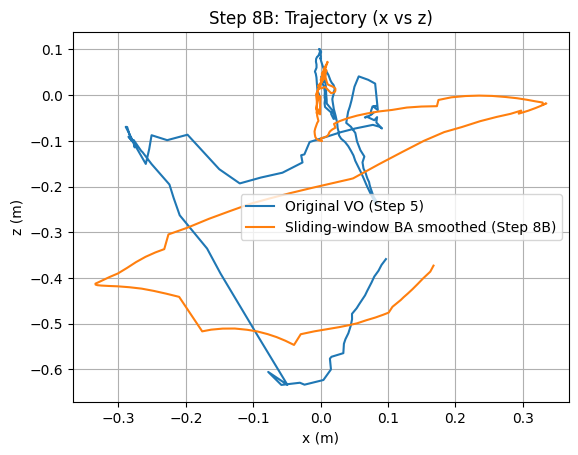
Sliding-window bundle adjustment reduced local reprojection error; global ATE remained approximately unchanged.
Loop Closure and Pose Graph Refinement
The pipeline also evaluates loop closure using keyframes and graph-based trajectory correction. The fresh run detected 65 loop edges, but the resulting optimization worsened aligned MH_01 trajectory error from 0.2317 m to 0.3300 m. This identifies loop validation and constraint weighting as unresolved engineering work.
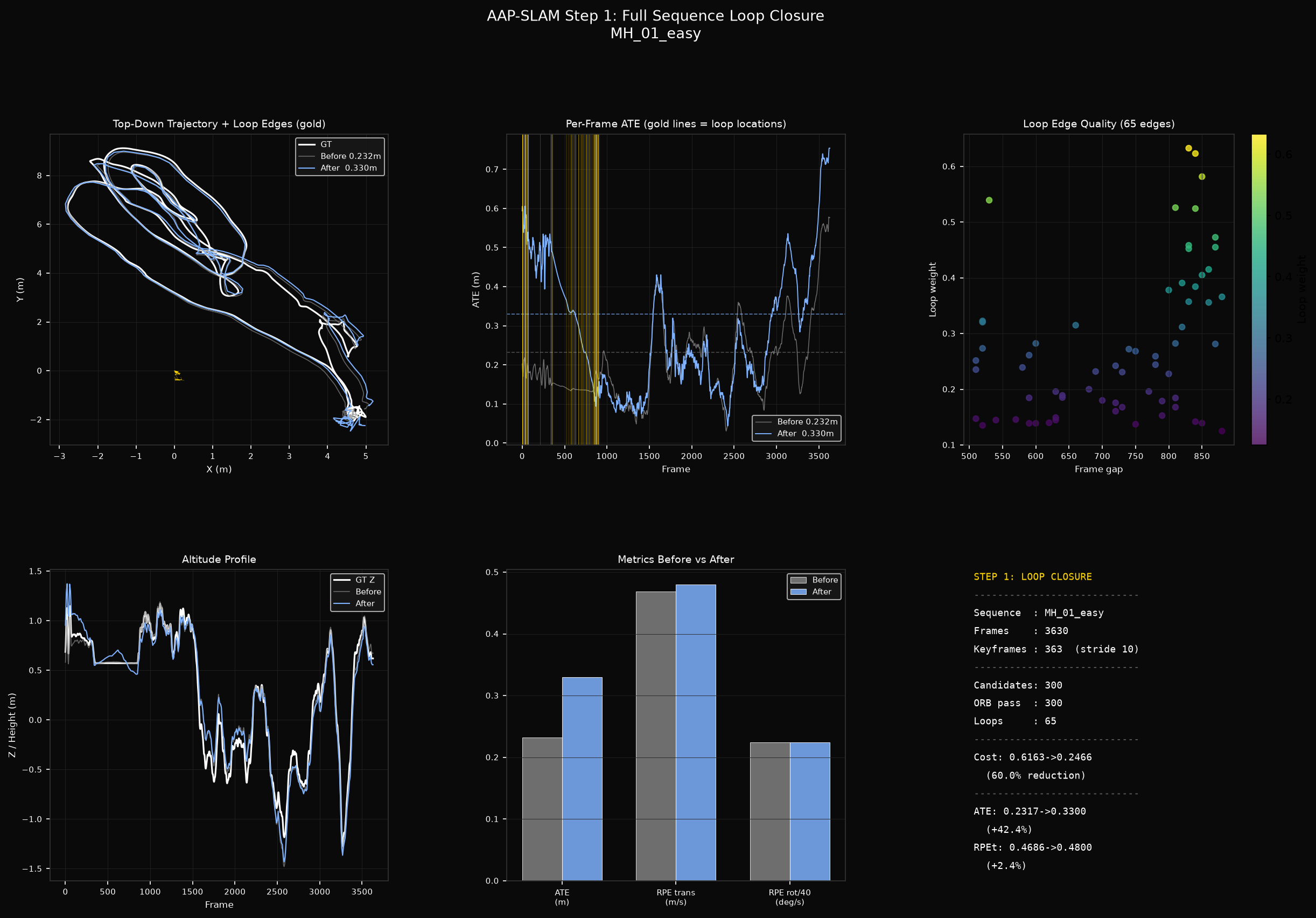
Negative result: graph cost fell by 60%, while aligned ATE increased by 42.4%.
Sparse 3D Mapping
Alongside trajectory estimation, the system reconstructed a sparse 3D landmark map from tracked stereo features. This demonstrated that the pipeline was simultaneously estimating motion and building a map.
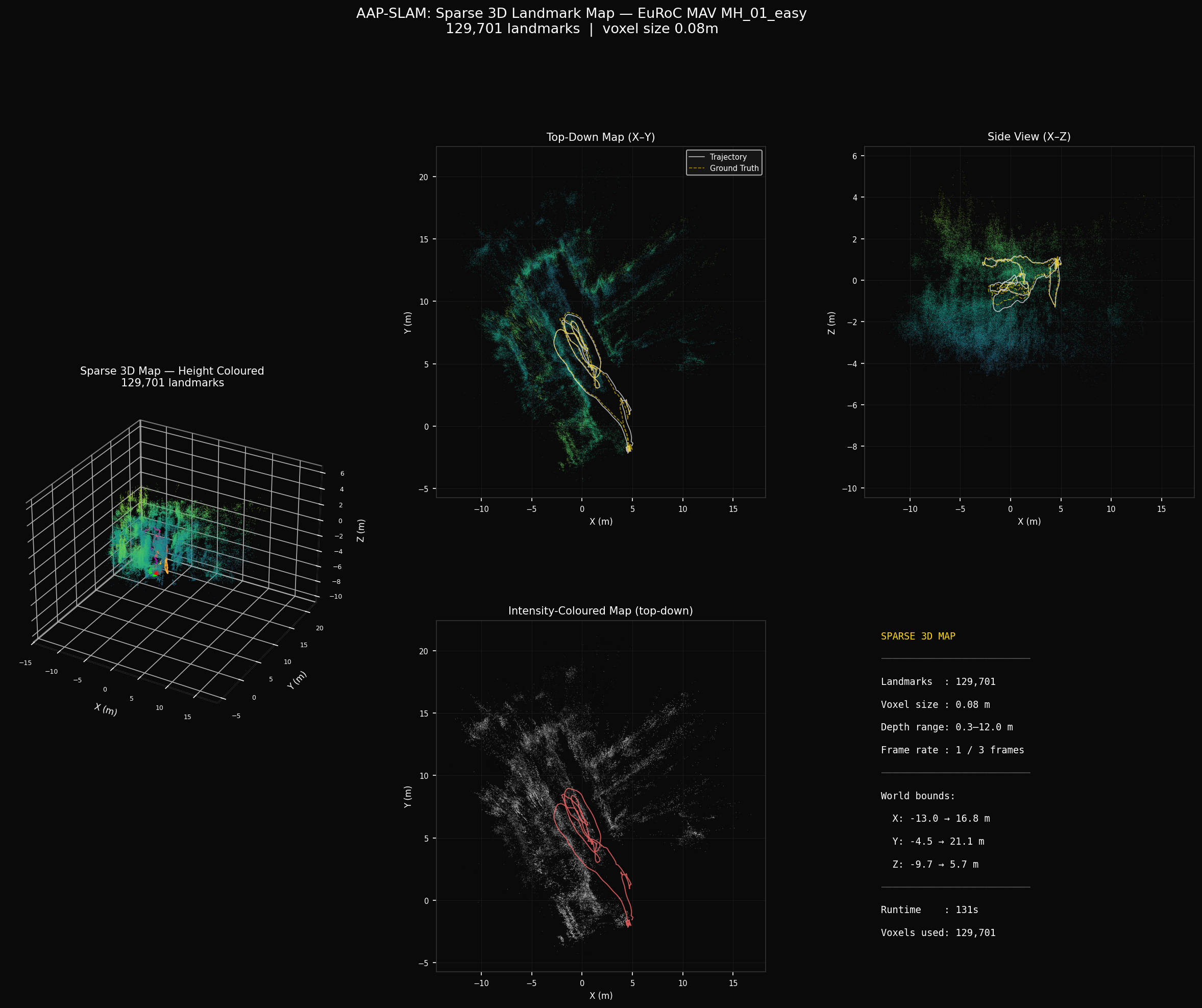
Sparse 3D landmark map reconstructed from stereo observations and tracked feature geometry.
Results and Validation
The notebook was rerun from a fresh kernel on August 8, 2026; all 29 cells completed without an error output. Results depend strongly on evaluation length and configuration. The tightly coupled 200-frame run over frames 50–249 improved ATE from 0.1924 m to 0.0304 m. The full-sequence benchmark measured 0.2364 m on MH_01_easy, 0.1690 m on MH_02_easy, and 0.3405 m on MH_03_medium, for a mean of 0.2486 m.
The fresh full-sequence loop-closure experiment found 65 loop edges but worsened MH_01 ATE from 0.2317 m to 0.3300 m (+42.4%). It is retained as a negative result showing that reducing an internal pose-graph cost does not guarantee better aligned trajectory accuracy.
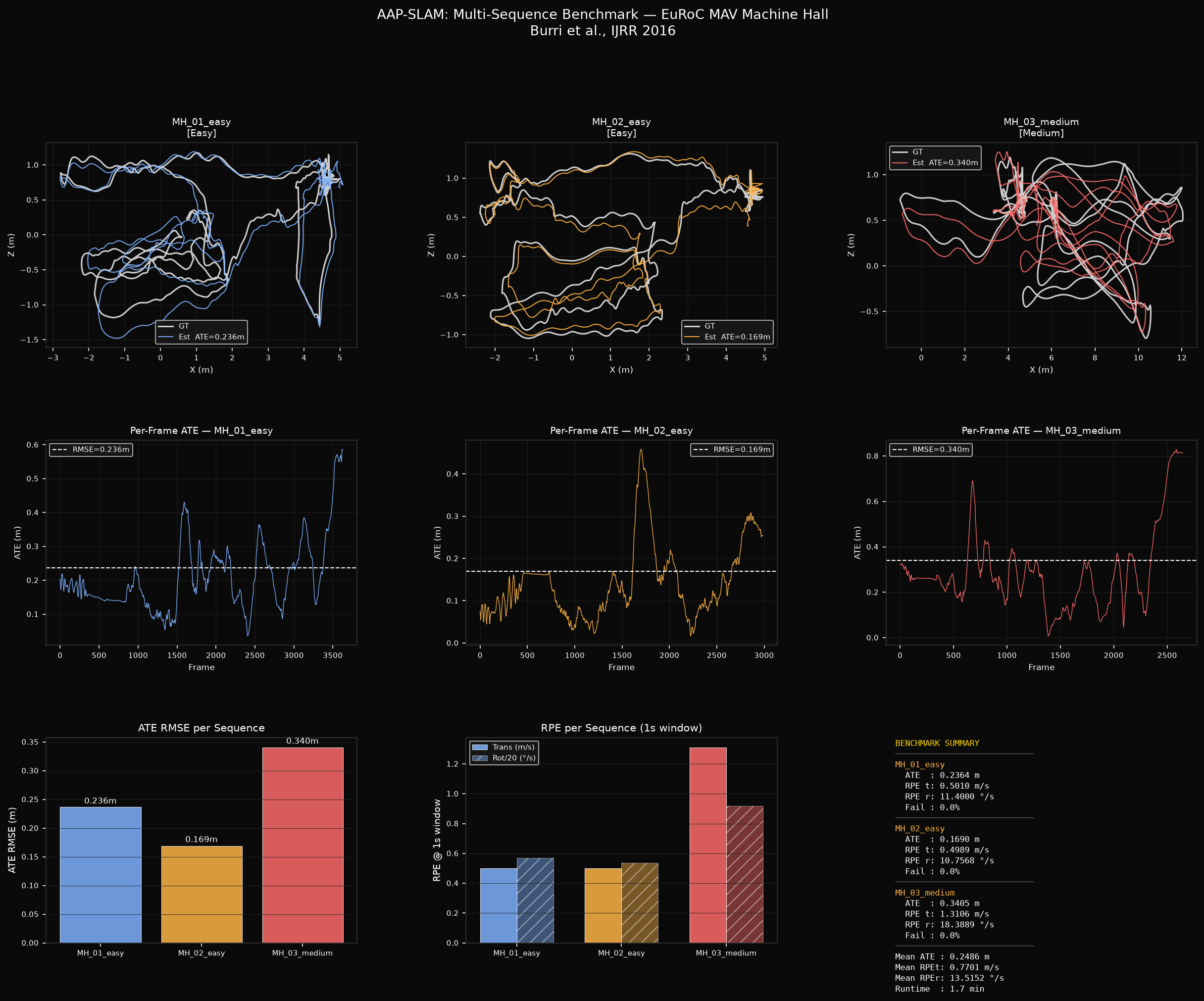
Key validated outcomes
- built a full stereo visual-inertial SLAM pipeline from frontend tracking through backend optimization
- improved trajectory quality significantly in the scoped 200-frame tightly coupled experiment
- demonstrated the effect of IMU-assisted estimation on drift reduction
- evaluated loop closure and documented that the current constraint design worsens full-sequence ATE
- generated a sparse 3D landmark map from stereo observations
Technical Stack
- Python
- OpenCV
- NumPy
- SciPy
- EuRoC MAV dataset
- stereo rectification and triangulation
- Lucas-Kanade optical flow
- visual odometry / pose estimation
- IMU-assisted pose refinement
- bundle adjustment
- pose graph loop closure
Engineering Insights
- frontend quality matters: stable tracking and stereo consistency strongly affect everything downstream
- stereo rectification quality is critical for reliable depth estimation
- IMU information is especially valuable for improving rotational stability and trajectory consistency
- backend optimization can add value, but must be validated against trajectory metrics rather than internal cost alone
- loop closure requires stronger geometric validation and weighting before it improves this full-sequence result
Future Improvements
- replace parts of the handcrafted frontend with more robust feature management under challenging motion
- improve loop candidate validation and graph edge selection
- extend from sparse mapping toward denser scene reconstruction
- benchmark more rigorously across additional EuRoC sequences and failure cases
- compare alternative visual-inertial fusion strategies for long-horizon drift reduction
Continue Exploring
See another system
Interested in the engineering behind this work? I am available to discuss robotics software, embedded systems, autonomy, controls, and robot-learning opportunities.